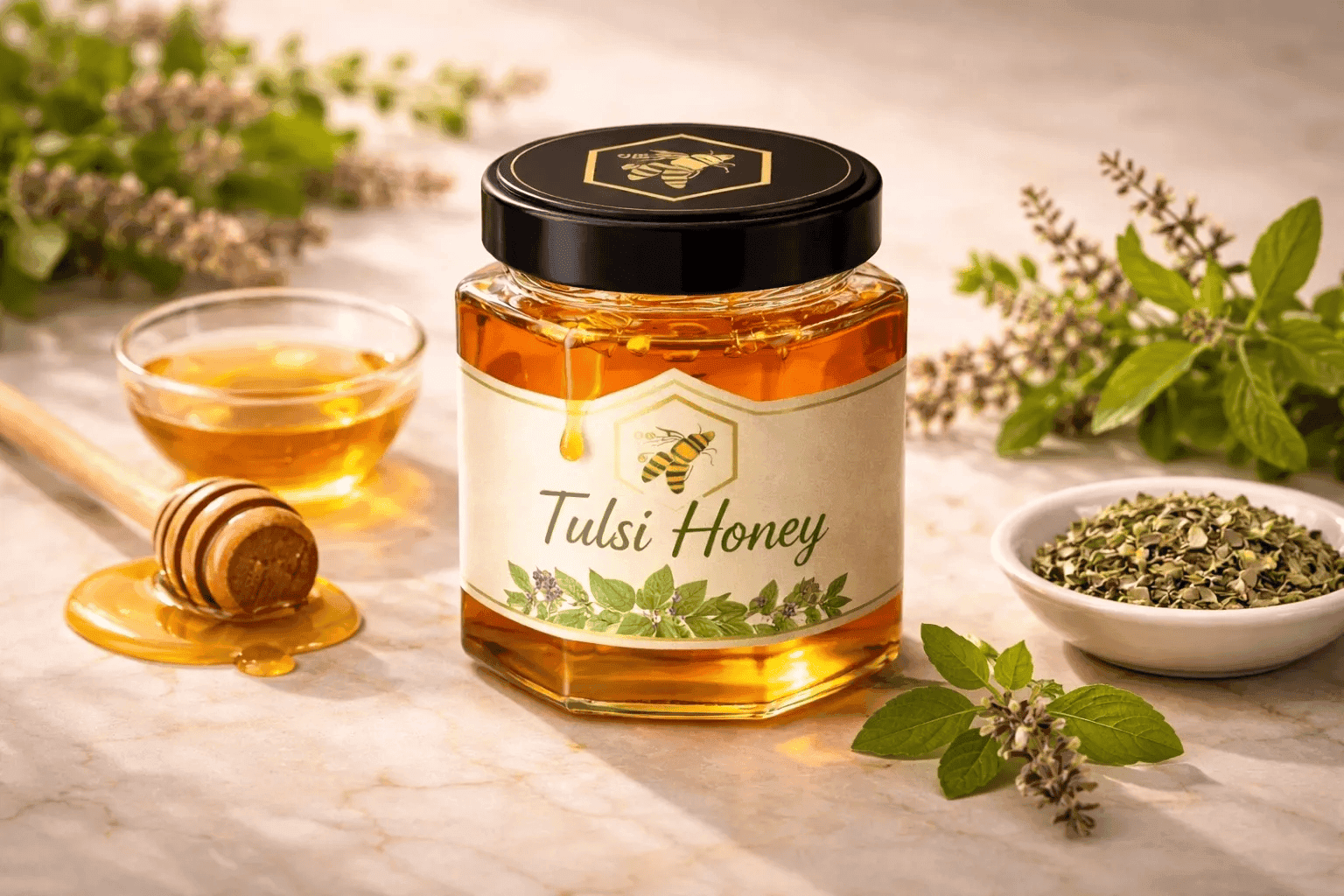
Tulsi, also known as holy basil (Ocimum tenuiflorum), has been a cornerstone of Ayurvedic medicine for over 3,000 years. When bees forage on tulsi flowers, the resulting honey carries many of the plant's beneficial compounds — creating what is arguably one of the most therapeutic honey varieties available in India.
What Makes Tulsi Honey Different?
All honey contains enzymes, antioxidants, and trace minerals. But tulsi honey has something extra: the volatile compounds from holy basil nectar. These include eugenol, rosmarinic acid, and ursolic acid — the same bioactive compounds that make tulsi a revered medicinal plant.
The result is a honey that is warmer, more herbaceous, and mildly peppery compared to wildflower or acacia honey. It is not just a sweetener — it is a functional food with a distinct medicinal character.
Proven Health Benefits
Immunity Support
Tulsi is classified as a rasayana (rejuvenating herb) in Ayurveda. Research published in the Journal of Ethnopharmacology confirms that tulsi extracts enhance immune cell activity. Tulsi honey retains many of these immunomodulatory compounds, making it a natural daily immunity booster — especially during seasonal transitions.
Respiratory Relief
One of the most well-documented uses of tulsi honey is for respiratory comfort. The combination of honey's throat-coating properties with tulsi's anti-inflammatory and expectorant effects makes it exceptionally effective for sore throats, coughs, and congestion. A teaspoon of tulsi honey in warm water with a pinch of black pepper is a traditional remedy still used in millions of Indian households.
Antioxidant Protection
A 2017 study in the Journal of Food Science and Technology found that monofloral honeys from medicinal plants had significantly higher antioxidant activity than generic multifloral honey. Tulsi honey, with its phenolic compounds from holy basil, offers strong free-radical scavenging activity that supports cellular health.
Digestive Wellness
Honey itself is a mild prebiotic that supports gut bacteria. Tulsi adds an antibacterial dimension — it has been shown to inhibit harmful gut bacteria like H. pylori while supporting beneficial strains. Regular consumption of tulsi honey (a teaspoon on an empty stomach) is a traditional approach to digestive wellness.
Stress and Adaptogenic Support
Tulsi is one of the most studied adaptogenic herbs. Adaptogens help the body manage stress by modulating cortisol and supporting the adrenal system. While the concentration of adaptogenic compounds in honey is lower than in tulsi supplements, regular consumption contributes to the overall adaptogenic effect — especially when combined with other tulsi preparations.
How to Use Tulsi Honey
The key principle with tulsi honey is to avoid heat. High temperatures (above 40°C) destroy the delicate enzymes and volatile compounds that make it medicinal. Here are the best ways to consume it:
- Morning ritual: A teaspoon in warm (not hot) water with lemon, first thing in the morning
- Kadha ingredient: Add to your homemade kadha after it has cooled to drinking temperature
- Tea sweetener: Stir into herbal tea once it is cool enough to sip
- Direct consumption: A spoonful before bed for throat and immunity support
- With turmeric: Mix with golden milk after it has cooled below 40°C
- On food: Drizzle over warm parathas, dosa, or porridge
How NectaBee Tulsi Honey Is Made
At NectaBee, our tulsi honey comes from apiaries stationed near organic holy basil fields in Madhya Pradesh during the late monsoon bloom. The bees forage predominantly on tulsi flowers, and we verify monofloral status through pollen analysis.
The honey is cold-extracted, coarse-strained (never ultra-filtered), and packed within 72 hours of harvest. No pasteurisation, no blending, no additives. Each batch is tested for moisture, diastase activity, HMF, and pollen profile — and the results are available via the QR code on every jar.
Who Should Use Tulsi Honey?
Tulsi honey is suitable for anyone above 12 months of age. It is particularly beneficial for:
- People prone to seasonal colds and coughs
- Those looking for a natural immunity booster
- Anyone transitioning from refined sugar to natural sweeteners
- Ayurveda practitioners and wellness enthusiasts
- Parents looking for a natural cough remedy for children
A Note on Crystallisation
Tulsi honey crystallises in 3-6 months — this is completely natural and a sign of purity. The crystallised form has a smooth, spreadable texture that many people prefer. If you want it liquid again, place the jar in lukewarm water (below 40°C) for 15-20 minutes. Never microwave honey.